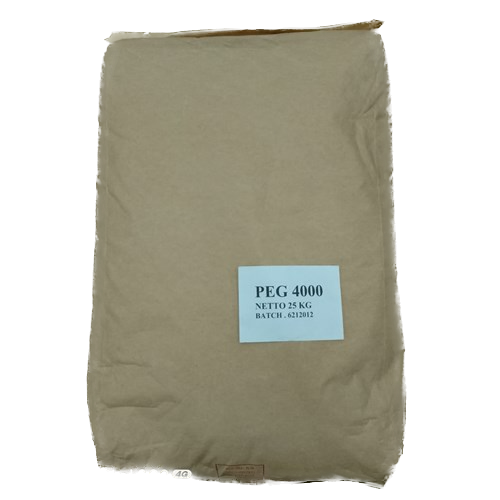
PEG 4000
In industrial settings, PEG 4000 (polyethylene glycol 4000) is primarily used as a lubricant, plasticizer, binder, and dispersant in various applications including rubber production, papermaking, resin manufacturing, and metal processing, due to its high solubility, non-toxicity, and ability to enhance the properties of different materials; it can also act as an anti-redeposition agent in detergents and a component in certain coatings and adhesives.
Key industrial applications of PEG 4000:
- Rubber industry:
Used as a processing aid to improve lubricity and plasticity during rubber compounding, enhancing the mold release properties and reducing friction during extrusion.
- Papermaking:
Acts as a finishing agent to increase paper smoothness and brightness, improving the paper’s quality.
- Resin production:
Incorporated into resin formulations to enhance flexibility and durability in coatings, adhesives, and plastics.
- Metal processing:
Functions as a lubricant and coolant during metalworking operations, reducing friction and heat generation.
- Detergent production:
Used as an anti-redeposition agent to prevent dirt particles from re-depositing on fabrics.
- Pigment dispersion:
Acts as a dispersant to evenly distribute pigments in paints and inks.
Important points to remember about PEG 4000:
- Molecular weight:
The “4000” in PEG 4000 refers to its average molecular weight, which influences its physical properties and applications.
- Solubility:
PEG 4000 is highly soluble in water, making it suitable for aqueous systems.
- Safety profile: Generally considered non-toxic and safe for industrial use when handled appropriately.
| Weight | 25 kg |
|---|---|
| Dimensions | 45 × 30 × 20 cm |
Related products


Other

Other
